
Low Vibration Compressor for Oxygen Concentrator: Why It Matters
A low vibration compressor for oxygen concentrator systems is not simply a comfort preference. Mechanical vibration from the compressor affects the performance, longevity, and reliability of every other component in the oxygen concentrator system. Understanding why vibration matters, which compressor technologies deliver the lowest vibration levels, and how to further reduce vibration through installation choices helps system designers and operators get the most from their oxygen equipment.
The oxygen concentrator contains sensitive components that vibration can damage or disturb: precision-machined zeolite sieve bed vessels, solenoid switching valves with finely lapped valve seats, pressure sensors and flow meters with delicate internal elements, and the molecular sieve material itself which can be physically degraded by sustained mechanical vibration.
Further Reading: Looking for the best oil-free air compressors for industrial and medical applications? Visit our comprehensive guide at
oil-free-air-compressor.com for expert reviews, specifications, and buying advice on premium oil-free compressor technology.
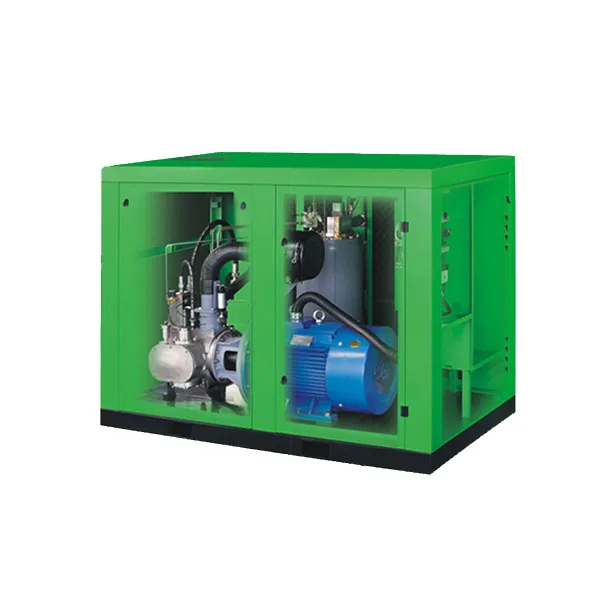
Low-vibration compressor technology protects sensitive oxygen concentrator components and prolongs system lifespan
How Vibration Affects Oxygen Concentrator Performance
Valve Seat Wear
Repeated micro-impacts from compressor vibration accelerate wear on the solenoid valve seats in the PSA sieve bed switching valves, reducing service life and increasing leak rates.
Sieve Bed Compaction
Sustained vibration can compact and redistribute zeolite molecular sieve granules within the adsorption vessels, creating channelling (preferential gas paths through the bed) that reduces nitrogen adsorption efficiency and oxygen purity.
Sensor Errors
Pressure sensors and flow meters are affected by sustained vibration, particularly at frequencies close to the sensor resonant frequency, introducing measurement errors that cause incorrect PSA cycle control.
Fastener Loosening
Compressor vibration transmitted to the concentrator cabinet gradually loosens fasteners on panel covers, pipe connections, and electrical terminal blocks. Regular retightening adds maintenance burden.
Noise Amplification
Vibration transmitted through floor structures can excite resonances in adjacent structures, amplifying noise levels beyond what would be expected from the compressor rating alone.
Patient Comfort
In homecare and clinical settings, compressor vibration transmitted through floors and walls disturbs patients and staff. Low vibration design is essential for acceptable noise floor in sensitive environments.
Compressor Technologies Ranked by Vibration Level
| Compressor Type | Typical Vibration Level | Typical Noise | Vibration Source |
|---|---|---|---|
| Linear free-piston | Below 0.5 mm/s RMS | Below 40 dB(A) | Almost no mechanical imbalance |
| Scroll (orbital) | 0.5 to 1.5 mm/s RMS | 40 to 48 dB(A) | Small residual orbital imbalance |
| Oil-free rotary vane | 1 to 3 mm/s RMS | 48 to 55 dB(A) | Vane-to-stator contact forces |
| Oil-free rotary screw | 1 to 4 mm/s RMS | 55 to 70 dB(A) | Rotor mesh frequency |
| Oil-free piston (1 cylinder) | 5 to 15 mm/s RMS | 55 to 68 dB(A) | Unbalanced reciprocating mass |
| Oil-free piston (2 cylinder) | 3 to 8 mm/s RMS | 52 to 65 dB(A) | Partial balance from opposed pistons |
| Oil-free piston (4 cylinder) | 2 to 5 mm/s RMS | 50 to 62 dB(A) | Better balance, higher order vibration |
Practical Vibration Reduction Measures for Existing Installations
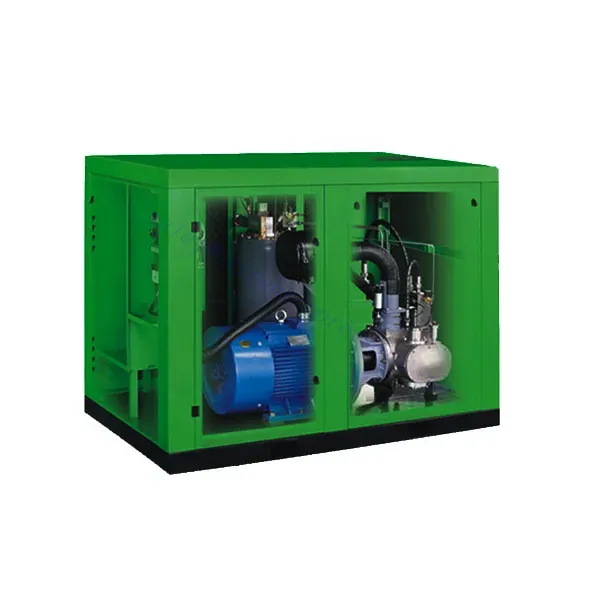
Proper mounting and flexible connections significantly reduce vibration transmission even from standard compressors
Anti-Vibration Mounts
Install the compressor on purpose-designed anti-vibration mounts (rubber-metal sandwich mounts or coil spring isolators) appropriate for the compressor weight and forcing frequency. Correctly selected mounts can reduce transmitted vibration by 80 to 95 percent.
Flexible Pipe Connections
Use short lengths of flexible reinforced hose at the compressor inlet and outlet to break the rigid vibration transmission path between the compressor and the system pipework. Flexible connections should be as short as practical while still providing adequate flexibility.
Inertia Base
For larger compressors, mounting on a heavy concrete inertia base (mass typically 2 to 5 times the compressor weight) reduces the vibration amplitude transmitted to the support structure by increasing the effective moving mass.
Floor Isolation
Where multiple compressors are installed and the floor structure is sensitive, isolating pads under the floor panel or raised floor sections can prevent cross-coupling of vibration between machines.
Balance Check
Confirm that the compressor is correctly balanced and all rotating components are within manufacturer balance tolerance during installation and after any major overhaul. Imbalance is the primary source of excessive vibration in otherwise well-designed compressors.
Frequently Asked Questions
Get Expert Advice Today
Send us your specifications and receive a tailored recommendation within 24 hours.